

A well-designed outdoor brick fire pit doesn’t just add warmth to a backyard. It defines how a property lives after sundown, and in Colorado, that matters more than most homeowners realize.
If you’re planning a premium outdoor living space in the Denver Metro area, the fire feature is likely the decision that shapes everything else: where the seating goes, how the patio flows, whether a pergola makes sense, and how the whole yard reads from the kitchen windows.
This article walks through what goes into a truly custom brick fire pit design for Colorado properties, covering materials, costs, site conditions, and integration with the broader outdoor space.
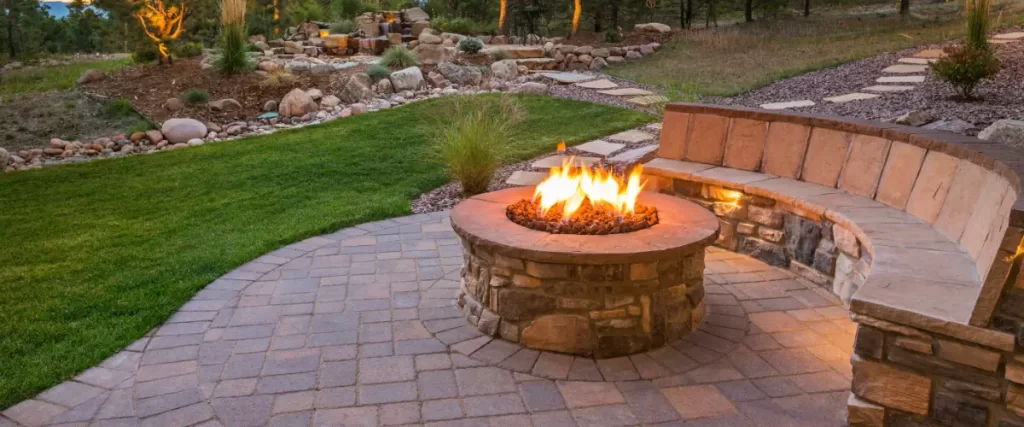
Why a Custom Brick Fire Pit Is the Centerpiece of Premium Outdoor Living
The best outdoor spaces have a gravitational pull. People naturally move toward them, and they always move toward fire.
A custom outdoor brick fire pit does something a freestanding steel ring or a prefab concrete bowl simply cannot. It anchors the space. It signals permanence and intention.
For homeowners investing in a fully designed backyard, it tells a design story that continues from the home’s architecture outward, through patio materials, into the seating arrangement, and up to the fire feature itself.
Beyond aesthetics, there’s a practical Colorado reason to choose a built-in brick fire pit: season extension. Denver’s evenings cool fast, and temperatures drop into the low to mid-60s after sundown in July, and dip into the 50s by September.
A properly placed fire feature lets you use your outdoor space comfortably through October and even into November. For families with investments in outdoor kitchens, pergolas, or covered patios, that extended usability is enormous.
Designing a Brick Fire Pit for Your Colorado Property
Site Selection for Denver Climate (Elevation, Wind, Snow)
Denver sits at 5,280 feet above sea level, and properties in communities like Cherry Hills Village, Greenwood Village, or the foothills push even higher.
At elevation, a few things change for fire pit design. Lower atmospheric pressure reduces air density, affecting combustion behavior and flame stability in wood-burning features. Wind patterns are also more pronounced and less predictable than at lower elevations.
A landscape architect will assess the prevailing wind direction on your specific lot before finalizing placement.
Positioning the fire pit so that smoke blows away from primary seating is a must. The pit’s height and bowl depth also matter, as a shallower bowl tends to produce more erratic flames in windy conditions.
Colorado’s freeze-thaw cycle is equally important. Water that infiltrates poorly compacted or improperly drained masonry will expand when temperatures drop, cracking mortar joints and causing the structure to shift over time.
Any quality brick fire pit installation in Colorado requires a compacted gravel base, proper drainage, and ideally, concrete footings below the frost line.
Skipping that prep work costs far more in repairs later than it saves upfront.
Materials: Brick Types, Stone Accents, Fire-Rated Cores

Not all brick is created equal, and this distinction matters a lot in Colorado.
Standard bricks have a porous structure with air pockets that trap moisture. Under high heat, that moisture can turn to steam fast enough to cause the brick to crack or, in extreme cases, fracture.
The inner chamber of any permanent fire pit should be lined with firebrick (also called refractory brick) rated to withstand temperatures of 1,800°F or higher.
Refractory cement, not standard mortar, binds those inner courses. The outer facade can use a wide range of decorative brick or stone, selected to complement the home’s architecture.
Popular accent choices for Denver-area properties include:
- Dry-stacked or mortared flagstone for a natural, terrain-appropriate look
- Cut bluestone for a cleaner, more geometric finish
- Local sandstone or granite veneer for mountain-adjacent properties
- Lava rock or reflective fire glass as media inside a gas-burning insert
For properties with existing stonework, retaining walls, or patio pavers, the goal is always visual cohesion. The fire pit should look like it was designed with the rest of the landscape.
Integration with Patio, Pergola, and Outdoor Kitchen
A custom brick fire pit rarely stands alone in a premium outdoor living design. It’s typically the terminus of a patio layout: the destination that draws you from the back door, past the kitchen island, and into the seating zone.
Land Designs by Colton’s hardscaping work regularly incorporates fire features into full-scale outdoor living environments: paver patios in herringbone or monochromatic patterns, overhead cedar or aluminum pergolas, outdoor kitchen islands on one side, and a fire pit anchoring the conversation circle.
When these elements are designed together from the start, everything works: traffic flow, sight lines, lighting circuits, gas line routing, and drainage all coordinate.
A pergola above or adjacent to the fire pit area adds both weather protection and a sense of enclosure that makes the space feel intentional. String lighting or integrated landscape lighting under the pergola also dramatically extends evening use.
Brick vs. Stone vs. Steel — The Premium Material Choice
| Material | Durability | Heat Performance | Aesthetic Range | Cost Range (Installed) |
| Firebrick + decorative brick | 20–30+ years | Excellent (slow heat absorption and radiation) | Traditional to modern | $3,000–$10,000+ |
| Natural stone (granite, basalt, sandstone) | 30–50+ years | Very good | Rustic to architectural | $5,000–$15,000+ |
| Steel or corten steel | 10–20 years (with maintenance) | Good | Industrial, minimalist | $2,000–$8,000 |
| Concrete block with stone veneer | 20–40 years | Good | Flexible | $4,000–$12,000+ |
For most Denver Metro homeowners prioritizing longevity and aesthetic alignment with high-value properties, brick with stone accents or full natural stone remains the top choice.
Steel features are low-maintenance and contemporary but tend to read as a lesser investment in premium outdoor living.
Cost Considerations for a Custom Brick Fire Pit
A fully custom outdoor brick fire pit designed for a premium Colorado property with firebrick lining, refractory cement, decorative stone accents, a gas line and burner, integrated seating walls, and proper compacted base work typically falls in the $7,000–$20,000 range.
When the fire feature is part of a broader outdoor living renovation that includes a paver patio, pergola, outdoor kitchen, and landscape lighting, total project budgets in the Denver Metro area typically range from $50,000 to $150,000.
The fire pit is rarely the single largest line item, but it tends to be the design anchor that determines the scale and layout of everything else.
It’s also worth noting: Colorado fire restrictions occasionally limit wood-burning features. Gas fire pits, however, are permitted under both Stage 1 and Stage 2 restrictions throughout the Denver Metro counties, as long as they don’t produce sparks or embers.
You can confirm current restriction levels at any time on the Colorado Division of Fire Prevention and Control’s fire restriction page. Many homeowners choose gas-burning brick fire pits precisely for year-round usability, regardless of seasonal fire conditions.
Real Project: A Bonnie Brae Backyard Centered on a Fire Feature
Land Designs by Colton has designed and built outdoor living spaces across the Denver Metro area, including fire features of all kinds.
One project that illustrates exactly how a fire pit can anchor an entire backyard redesign is this renovation in Bonnie Brae, Denver.
The backyard was 1,200 square feet with a lot of untapped potential. An old garage and a pond were eating up usable lawn space, so the project started with a full demolition.
With a clean slate, we designed it with intention from the ground up:
- Custom fire feature positioned as the focal point of the patio
- Copthorne paver patio in three colors, laid in a herringbone pattern with a beige cream accent border
- 16×16 rough-cut cedar pergola with traditional architectural cuts
- New lawn, plant materials, and irrigation, completing the softscape around the hardscape
- Drainage solution engineered to keep the space dry and functional year-round
The project came in at $145,000, with the patio and steps landing material being the largest single line item at $20,000. The fire feature, true to form, wasn’t the most expensive piece, but it was the one that tied the whole space together.
Custom Brick Fire Pit Design in Colorado FAQ
What kind of brick should be used for a fire pit in Colorado?
The inner chamber needs firebrick, a dense, heat-resistant refractory material rated to 1,800°F and above, far beyond the temperatures a residential fire pit reaches.
Do I need a permit for a custom fire pit in the Denver Metro area?
Usually, yes, especially for gas-connected fire features or anything attached to a permanent patio structure. At Land Designs By Colton, we handle permitting as part of the project scope.
Can a brick fire pit be used during Colorado fire restrictions?
Gas fire pits are permitted under both Stage 1 and Stage 2 fire restrictions across Denver Metro counties, provided they don’t produce sparks or embers.
How long does a well-built brick fire pit last in Colorado?
With firebrick construction, proper drainage, and refractory mortar, a quality brick fire pit will last 20–30 years or more. Mortar joints should be inspected annually and typically need repointing every 15–25 years, depending on Colorado’s freeze-thaw exposure and use frequency.
Can the fire pit be integrated into an existing patio?
Absolutely. The key is ensuring the existing base is adequate for the added load and heat exposure. An experienced hardscaping contractor will assess the existing foundation and make any necessary corrections before integration.
What’s the best shape for a brick fire pit for a large gathering space?
Round fire pits naturally create a communal seating circle, which works well for larger properties. Square or rectangular designs integrate more cleanly into rectilinear patio layouts. Shape selection should follow from the patio geometry and seating plan, not the other way around.
Talk to a Landscape Architect About Your Outdoor Living Design
The decisions involved in a custom brick fire pit design for a Colorado property are genuinely layered. Site conditions, drainage, materials, gas line routing, permit coordination, and integration with the broader outdoor space… each piece affects the others.
The easier path is a conversation with a landscape architect who does this work regularly in Denver.
At Land Designs by Colton, we design fire features as part of cohesive outdoor living spaces. Call us at (720) 580-3677 or message us here.