

When it comes to landscaping, choosing the right tree to plant is critical.
As landscape designers who work in Colorado every day, we’ve seen firsthand which trees thrive here and which don’t.
We’ll cover the best evergreen and deciduous trees for Colorado, and break down the best xeriscape-friendly trees, shrubs, perennials, and grasses.
Finally, we’ll tell you the honest truth about watering, including why that rain barrel in your backyard might be doing more harm than good.
Why Tree Selection Matters in Colorado
Before you plant anything, there are four things worth thinking through carefully:
- Climate: Colorado spans multiple hardiness zones, with late-season hard freezes, intense UV at elevation, and wind exposure across much of the state. The tree needs to handle it all.
- Water requirements: Colorado averages 14-17 inches of precipitation a year. Know how much supplemental irrigation a tree needs before you commit to it.
- Soil conditions: You'll find everything from sandy loam to heavy clay depending on where you are. Some trees are adaptable, others are more picky.
- Long-term growth habits: How big will it get? How fast? Will the root system cause problems near a foundation or sidewalk?
If you’re planning a larger planting project, working with a professional landscape design and build team from the start will help you avoid costly mistakes down the road.
Every tree in our list was chosen with these factors in mind, so let’s get into it.
5 Best Evergreen Trees To Plant In Colorado
Evergreens are workhorses in Colorado landscapes. They provide year-round color, act as windbreaks, and hold their visual weight through winter when deciduous trees go bare.
-
Colorado Spruce
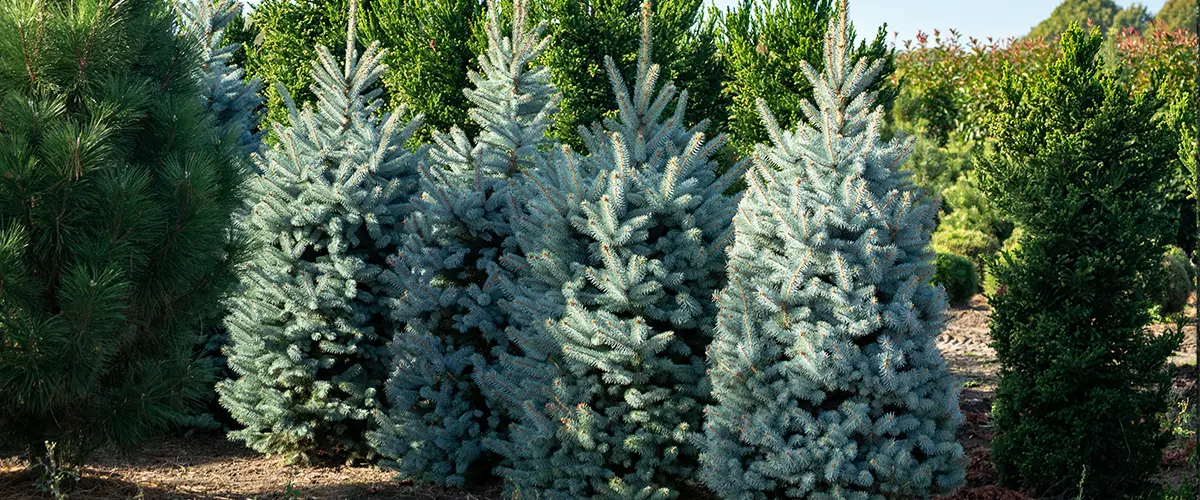
The Colorado Blue Spruce’s silvery-blue needles give it a striking, distinctive look that holds up all year.
It grows in a clean pyramidal shape and handles heavy snow without complaint. Mature trees can reach 75 feet tall, so give them room.
Why it’s good for Colorado: As the state tree, it’s naturally dialed in to the region’s climate and soil conditions. It tolerates drought, thrives at varying altitudes, and its sturdy branches hold up against heavy snow and strong winds.
-
Ponderosa Pine
The Ponderosa Pine’s bark turns orange-brown and, when warmed by the sun, smells faintly of vanilla.
It’s native to Colorado, grows straight and tall up to 60 feet, and its deep root system makes it genuinely tough in drought conditions.
Why it’s good for Colorado: Native to the state, it thrives in Colorado’s diverse climate and soil conditions. Its deep root system makes it highly resilient to both drought and wind, and it performs especially well at higher altitudes.
-
Wichita Blue Juniper
If you want a smaller evergreen with bold blue-silver color, the Wichita Blue Juniper is a fantastic pick.
It’s dense and formal in shape. It handles drought, cold, and wind without much fuss, making it one of the more reliable, low-maintenance choices on this list.
Why it’s good for Colorado: Its high tolerance for drought, cold, and wind makes it one of the most adaptable evergreens for Colorado landscapes.
-
Big Tuna Mugo Pine
This is a great option when you want an evergreen without the height.
Big Tuna stays compact and mounding, making it perfect for smaller yards, rock gardens, or foundation plantings. Drought-tolerant once established, it’s genuinely low-maintenance after the first couple of seasons.
Why it’s good for Colorado: Its cold hardiness makes it well-suited to Colorado’s climate. It handles temperature swings and dry conditions without issue.
-
Vanderwolf's Pine
Vanderwolf’s is a limber pine with a graceful, slightly irregular form and soft blue-green needles.
It has a more naturalistic look than the structured spruce or juniper, making it a great choice for landscapes that blend with Colorado’s natural character.
Why it’s good for Colorado: Limber pines are native to the Rocky Mountain region, giving this tree an inherent tolerance for Colorado’s altitude, cold snaps, and dry conditions. It’s a natural fit for the state’s landscape.
5 Best Deciduous Trees To Plant In Colorado
Deciduous trees bring seasonal drama, shade, and a warmth to the landscape that evergreens can’t replicate.
These five recommendations perform consistently well across Colorado’s climate zones.
-
Kentucky Coffeetree

Underused and underrated, the Kentucky Coffeetree (Gymnocladus dioicus) has a sculptural quality that looks interesting even in winter when it drops its leaves.
It can hit 60–75 feet at maturity and has a bold, architectural presence that very few other trees can match.
The one honest downside: it’s a slow starter and will drop large seed pods that need to be cleaned up.
Why it’s good for Colorado: As a native tree, it’s well-suited to Colorado’s diverse climate and handles extreme temperature swings without complaint. It tolerates a wide range of soil types and is highly drought-tolerant once established.
-
Aspen
Few things feel more “Colorado” than a stand of Aspens in October. The Quaking Aspen (Populus tremuloides) turns brilliant golden yellow every fall, and grows fast.
Just know that Aspens spread by root shoots, so they’re better suited for larger spaces where that expansion is welcome.
Why it’s good for Colorado: Native to Colorado, it’s naturally adapted to the state’s varied climate and thrives at higher altitudes. It does best in well-drained soils and is a natural fit for mountain and foothill properties.
-
Red Point Maple
A reliable performer with excellent fall color, the Red Point Maple offers a tighter, more upright growth habit than many maples. It’s a great fit for smaller yards.
The red fall display is genuinely impressive, and it handles Colorado’s cold without issue.
Why it’s good for Colorado: Cold-hardy and adaptable to Colorado’s varied soil types, it holds up well through the state’s temperature extremes. Its upright form also makes it less vulnerable to snow and wind damage.
-
Shade Master Locust
The Shade Master Locust is one of the best options for Denver and Front Range landscapes.
It leafs out quickly in spring and provides excellent filtered shade through summer. It’s also fast-growing, heat-tolerant, and drought-resistant once established.
Why it’s good for Colorado: Its drought tolerance and heat resistance make it a natural fit for Colorado’s drier climate zones. It’s also resistant to many of the issues that affect other locust varieties, making it a lower-maintenance choice for Front Range properties.
-
Heritage Oak
The Heritage Oak is a vigorous, adaptable variety that develops into a broad, handsome canopy over time.
It grows faster than you’d expect. Plant one for the next generation, it’ll be there for a very long time.
Why it’s good for Colorado: Its deep root system makes it highly resilient to wind, and its drought tolerance improves significantly after establishment. It handles Colorado’s soil variability and temperature extremes better than many other oak varieties.
The Best Xeriscape Trees, Shrubs, and Plants for Colorado
If water efficiency is a priority (and in Colorado, it really should be), xeriscape landscaping is worth a serious look.
Xeriscaping is sometimes misunderstood. It doesn’t mean gravel and cactus. Done well, it means a lush, colorful, low-maintenance landscape that requires little irrigation.
Top 4 Xeriscape Trees
| Tree | Why It Works in Colorado |
|---|---|
| Amur Maple (Acer ginnala) | Compact, brilliant fall color, very cold-hardy |
| Oak | Drought-tolerant once established, long-lived |
| Hawthorn | Tough, attracts birds, handles clay soil |
| Purple Leaf Plum | Ornamental, bold color, manageable size |
The Best Xeriscape Shrubs and Perennials
Some of the best shrubs for low-water Colorado landscapes include:
- Serviceberry — one of the hardiest, beautiful spring blooms and edible berries
- Apache Plume — native, feathery seed heads, incredibly tough
- Ninebark — great foliage color, adaptable to most soils
- Western Sand Cherry — compact, drought-resistant, fragrant white flowers
- Sumac — stunning fall color, spreads naturally as a groundcover shrub
- Lilac — a Colorado classic, low water once established, incredibly fragrant
- Manzanita and Mormon Tea round out the palette for more xeric conditions
For perennials, you’ve got excellent options like: Moonshine Yarrow, Red Yucca, Ivory Tower Yucca, Red Valerian, Autumn Joy Sedum, Midnight Salvia, Russian Dwarf Sage, Coneflower, Iris, Catmint, Rocky Mountain Penstemon, Thyme, Creeping Phlox, and Ice Plants.
Xeriscape Grasses: Our Recommendations
Ornamental grasses are some of the most underrated plants in Colorado landscaping. They’re water-wise, low-maintenance, and they add movement and texture that few other plants can match.
Blue Oat Grass, Blue Grama, Fountain Grass, Little Bunny Grass, Little Bluestem, and Muhly Grass are all excellent choices for Colorado.
Little Bluestem in particular is a Colorado native that turns copper-red in fall and looks beautiful well into winter.
You can explore a great selection of xeriscape-friendly plant material at Alameda Wholesale Nursery, which carries many of these species and specializes in Colorado landscapes.
More to read: Drought-Tolerant Plants For Your Garden
A Note on Watering Xeriscape Plants
It’s important to know that xeriscape plants need consistent water when they’re young.
- Year 1: Water regularly. The roots are establishing, and they need support.
- Year 2: Root systems are developing. You can start pulling back.
- Year 3: Depending on the species and weather, reduce irrigation by up to 60%. That's where the savings really start to show.
Don’t rush that timeline. Drought-tolerant doesn’t mean drought-proof during establishment.
Here’s another thing worth knowing: Colorado legalized rainwater collection in 2016 (up to two rain barrels per household), and you’ll sometimes see rain gardens recommended as part of xeriscape design.
We actually steer our clients away from that approach.
Standing water in barrels and collection basins creates a real mosquito and insect problem, especially during the summer. It’s not worth the tradeoff.
The right approach for xeriscape plants is a proper drip irrigation system. Drip gets water directly to the root zone, minimizes evaporation, and keeps the surface dry enough to discourage pests.
Best Trees To Plant In Colorado FAQs
Among the trees that actually perform well in Colorado, the Shade Master Locust and Quaking Aspen are your best bets for faster growth. Both are solid choices if shade is the priority and you don’t want to wait for decades.
Colorado Blue Spruce is a natural fit for northern Colorado, handling the cold, snow, and wind that the region is known for. Among deciduous options, the Quaking Aspen performs particularly well at higher elevations in the north, and the Shade Master Locust is a strong choice for lower-elevation properties.
The Heritage Oak is an excellent choice for Colorado. It’s more vigorous and adaptable than many other oak varieties, grows faster than you’d expect from an oak, and becomes genuinely drought-tolerant once the roots are established.
For Denver’s urban climate, the Shade Master Locust, Red Point Maple, Kentucky Coffeetree, and Heritage Oak all perform well. Quaking Aspen works if you have the space. For evergreens, Colorado Blue Spruce and Wichita Blue Juniper are both excellent choices.
The most popular tree in Colorado is the Colorado Blue Spruce (Picea pungens). This majestic tree is not only a state tree but is also widely loved for its silvery-blue needles and stately appearance.
It’s highly adaptable, thriving in a variety of soil types and climates found across the state. The Colorado Blue Spruce provides year-round color and serves as a superb choice for a shade tree or privacy screen.
Its ability to withstand the state’s variable weather conditions and its minimal maintenance requirements further contribute to its popularity among Colorado homeowners and landscapers.
Not always. Native and adapted species often do fine without supplemental fertilizer in Colorado’s soils. A soil test will tell you if there are deficiencies worth addressing. Over-fertilizing can actually push weak, fast growth that’s more susceptible to pests and weather stress.
Get The Perfect Trees Planted By Colorado's Expert Landscapers
It’s clear there’s a lot to think about before a single tree goes in the ground, from species selection to soil conditions, irrigation planning, mature sizing, and hardiness zones.
The simplest path for most Colorado homeowners is to hand this off to a team that already knows the answers.
At Land Designs by Colton, we handle the full landscaping process, from initial design through installation and beyond. No guesswork, no mismatched plants, no irrigation headaches.
Our focus is on understanding your needs and lifestyle to create outdoor spaces that are not only aesthetically pleasing but also functional and sustainable. Our designs are inspired by Colorado’s natural beauty and tailored to withstand its diverse weather conditions.
For a consultation or to learn more about our services, please call us at (720) 580-3677 or reach out via our contact page. Let Land Designs By Colton take care of your landscape design and build needs in Colorado.