

Most Denver homeowners start their backyard project with a Google search and end up more confused than when they started. Landscape architect? Landscape designer? Contractor? The titles blur together fast.
Hiring a landscape architect in Denver is a much smoother process when you understand what each step involves, what credentials actually mean, and what separates a professional who’ll protect your investment from one who won’t. That’s exactly what this article covers.
Why “Credentialed” Matters in Denver Metro
In Colorado, the title “landscape architect” carries real legal weight. The Colorado State Board of Landscape Architects, operating under the Division of Professions and Occupations (DPO) within Colorado’s Department of Regulatory Agencies, licenses landscape architects at the state level.
Getting there is not simple. Candidates must earn an accredited degree, complete supervised professional experience, and pass all four sections of the Landscape Architect Registration Examination (L.A.R.E.), a rigorous national exam administered by CLARB. Colorado landscape architect licenses must be renewed every two years.
Why does this matter to you?
Because it’s the difference between someone who has formally proven their knowledge of site grading, drainage, soil health, structural load, and sustainable design, and someone who just has a good eye for plants. Both have their place. But for a full outdoor living transformation in the Denver metro, credentials matter.
Anyone can call themselves a landscape designer. Not everyone can call themselves a licensed landscape architect.
The 8-Step Process Working With a Landscape Architect
Here is what the process looks like in practice, start to finish.
Step 1: Initial Consultation (Free Phone Call)
You reach out, they pick up. The first conversation is usually short, maybe 15 to 20 minutes. You describe your space, your priorities, and what you’re hoping for.
A good landscape architect uses this call to listen, ask the right questions, and figure out whether the project is a good fit before anything formal begins.
Step 2: On-Site Visit and Goals Discovery
The architect comes out, walks your property, and looks at the things no photo can reveal, like drainage issues, grade changes, soil conditions, and how sunlight hits different parts of your yard at different times.
They also ask about how you actually use the space. Do you entertain? Do you have kids or dogs? Is there a view you want to frame or an eyesore you want to block?
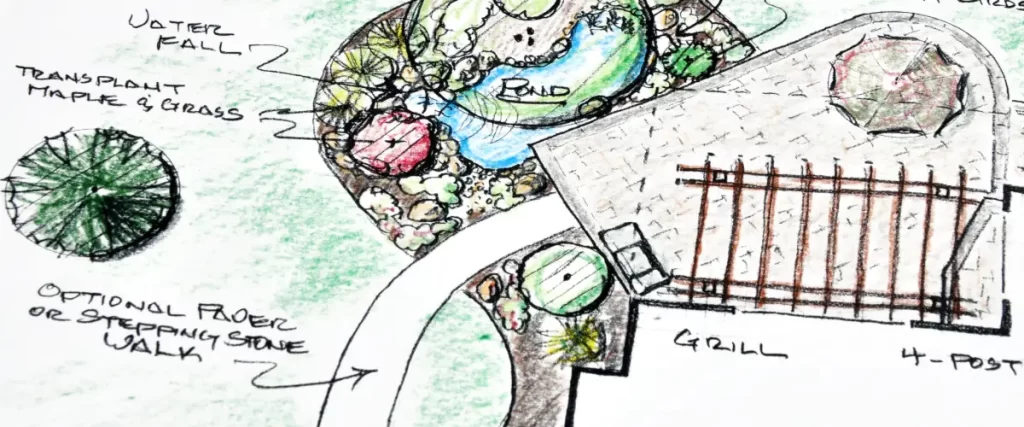
Step 3: Design Proposal + 3D Rendering
After the visit, the design begins. A 2D conceptual sketch typically takes about 3 weeks to complete.
Once you sign off on the layout, the project moves into the 3D rendering phase, giving you a realistic visual of the finished space before anything is built.
The entire design process generally wraps up within 4 weeks, depending on complexity and revisions.
Step 4: Material Selection
Pavers, stone, composite or wood decking, native Colorado plants, and lighting systems. These choices get made together, with the architect guiding you based on your aesthetic preferences, your budget, and what actually holds up to Denver’s freeze-thaw cycles.
The wrong material can look great for a season and fail by the third winter.
Step 5: Permit Handling and HOA Approvals
\In Denver, retaining walls over 4 feet require a building permit and stamped, engineered drawings. Drainage modifications and certain structural elements can also trigger permits. Many HOAs add another layer of review.
A credentialed landscape architect handles this paperwork, so it doesn’t fall on you.
Step 6: Site Prep and Material Ordering
Before installation starts, the site is prepared, and materials are ordered.
Timing matters here more than most homeowners realize. A well-organized team coordinates delivery schedules so the project doesn’t stall midway waiting on a pallet of stone.
Step 7: Installation

This is when the yard transforms. Retaining walls go up, pavers get laid, irrigation lines go in, and plants take root.
With a firm that designs and builds in-house, the person who created the vision oversees the crew bringing it to life. That continuity protects the design at every stage.
Step 8: Final Walkthrough + 1-Month Follow-Up
Once installation wraps up, you walk the finished space together.
Every detail gets reviewed. A follow-up at the one-month mark gives you a chance to flag anything that needs attention after the plants have settled and the irrigation has run a few cycles.
What to Look for in a Denver Landscape Architect
Credentials (Degree + State License)
Ask directly whether the architect holds an accredited degree and is registered with Colorado’s State Board of Landscape Architects.
You can verify any landscape architect’s license through the DPO’s online license lookup tool. If they can’t give you a registration number, that tells you what you need to know.
Insurance and Bonding
General liability insurance protects you if something goes wrong during installation on your property. Workers’ compensation matters too.
Ask for a certificate of insurance before any agreement is signed, not after.
Manufacturer Certifications (Techo-Pro, Unilock, ICPI)
Certifications from respected hardscape manufacturers like Techo-Bloc’s Techo-Pro program and Unilock’s Authorized Contractor program, along with ICPI certification from the Interlocking Concrete Pavement Institute, signal that a team understands the technical standards behind proper installation.
Portfolio Depth in Your Neighborhood
Denver’s neighborhoods vary in lot size, soil type, drainage conditions, and HOA requirements.
A portfolio that includes projects near yours, whether in Washington Park, Hilltop, West Highland, or Ken Caryl, gives you actual evidence of local knowledge rather than just general experience.
Red Flags to Avoid
Watch for these before you sign anything:
- No physical address or local office. Firms without real roots in the Denver metro often lack Colorado-specific knowledge of climate, soil, and municipal permitting.
- Vague timelines. A professional commits to milestones in writing. “A few weeks” is not a schedule.
- Verbal-only agreements. Every detail of scope, cost, and timeline belongs in a written contract.
- Third-party subcontracting for installation. If the company that designs your yard hands the build to a crew they’ve never worked with, the design intent disappears fast.
- No license verification available. If they can’t provide a Colorado state registration number, don’t move forward.
Questions to Ask Before You Sign a Contract
- Are you registered with the Colorado State Board of Landscape Architects?
- Will you handle all permit applications and HOA submissions?
- Who specifically will be on-site during installation, and do they work for you directly?
- Can you show me completed projects in my neighborhood or on properties with similar site conditions?
- How do you handle scope changes or unexpected issues that come up mid-project?
- What does your follow-up process look like after installation is complete?
FAQ: Hiring a Credentialed Denver Landscape Architect
How much does it cost to hire a landscape architect in Denver?
Costs depend on scope and materials. At Land Designs by Colton, the design starts at $1,200. Full outdoor living projects in the Denver metro, including patios, retaining walls, irrigation, and planting, have ranged from around $25,000 to $48,000, depending on what is included and the complexity of the site.
What is the difference between a landscape architect and a landscape designer?
A landscape architect holds an accredited professional degree and must pass the L.A.R.E. before the state of Colorado allows them to use the title. They use advanced design software and are equipped to handle complex grading, drainage, and structural elements from the ground up. A landscape designer may have strong skills and real-world experience, but in Colorado, the title is not subject to state licensing requirements.
How long does the design process take?
The 2D conceptual sketch is completed about 3 weeks after the on-site consultation. The full design process, including the 3D rendering phase, typically wraps up within four weeks. The timeline can vary based on the number of revisions and the scale of the project.
Can a landscape architect also handle installation?
Yes, and it is actually the better outcome when they do. Firms that design and build in-house keep the same team involved from concept through final walkthrough. That consistency means fewer surprises and a finished product that actually matches the design.
Start Your Landscape Architecture Project with Land Designs by Colton
The most practical thing you can do is skip the research spiral and just talk to someone who has already done this across 500-plus Denver-area homes.
At Land Designs by Colton, you work directly with Jonathan Colton, a state-licensed landscape architect and the owner who brings 25 years of design experience to every project. He handles the design and oversees installation with his in-house crew.
If hiring a landscape architect in Denver has felt like more trouble than it’s worth, one conversation usually changes that. Call us at (720) 580-3677 or message us here.